Thursday, October 05, 2006

TA-ncient History #5: The First Ad

Some of you old timers might remember the first print advertisement for Total Annihilation. I think that ad scored a first for Cavedog. Or a close second... maybe third. Definitely no more than sixteenth overall. I'm positive.

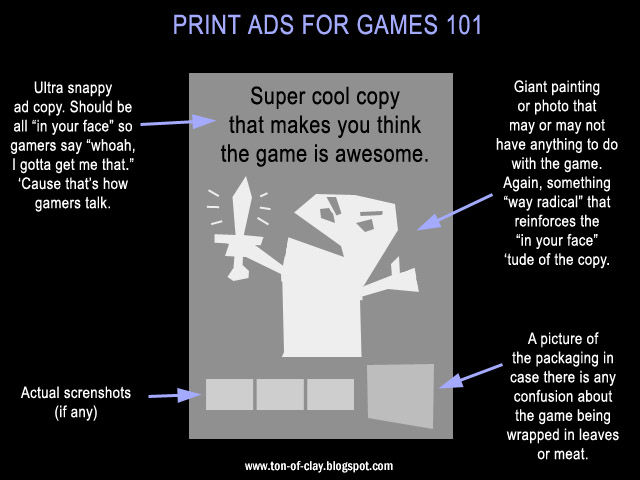
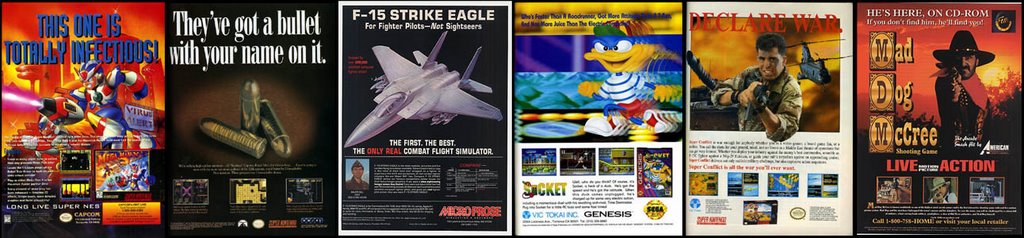
Y'see, print ads for games almost always followed a time-honored format. Crack open any game magazine from before 1997 and you will see that the advertisements are remarkably homogeneous. They all looked something like this:

This dates back to the time when game art was relatively crude, so some sort of swanky art or a big juicy photograph would be used to build an image for a game. The game itself usually couldn't do that. A character with only twelve pixels just doesn't have a lot of presence.


The thing is, game ads still looked like that decades later, even after in-game art started to look reasonably slick. It's a common design even today. I don't blame ad agencies for doing this. I'm sure they can crap out nineteen of these in a single afternoon and still have time for some blow and a round of golf. And to be fair, it's a pretty common approach to any print ad. It works for selling lotion and cars... Why not games?

That is exactly the sort of ad the marketing firm working for GT Interactive showed us when they came by in early 1997. We hated it immediately. We knew the game would have only one or two print ads before it launched and we wanted them to have maximum impact. Chris and I were adamant that we sell the game with the game. We insisted that the ad feature a full two-page screenshot.

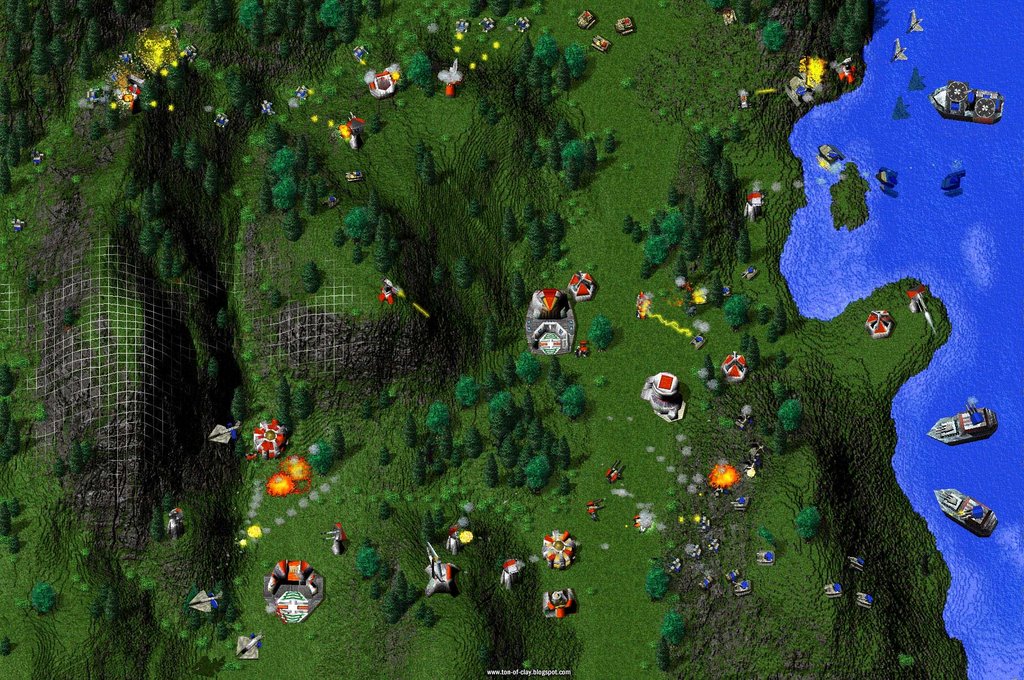
I don't recall seeing this before. It's not like we thought it up. It was just a matter of time before giant screenshots became commonplace, but Total Annihilation was certainly one of the first games to do it. There was some resistance from the agency. The concern was that (gasp!) the pixels would be visible since a computer game couldn't match the print resolution of a magazine. That sounded fine to us. It would absolutely show gamers what they were getting.

We did have one advantage. GT Interactive owned the fold-out ad space inside the cover of all the major PC gaming magazines for a couple years running. This prime real estate was mostly used for big versions of the standard formula above, but we would get that spot for one or two display ads before the game hit store shelves. Chris, Ron and I wrote the basic copy which the ad folks polished up a bit. I did a rough layout then went to work creating a big, big screenshot. Here is the original image:

Okay. This was the original image, but Blogger crunched it down quite a bit.

A few months later, Total Annihilation would later have a built-in screen shot key command. We could take snapshots like this with no problem - but we didn't have that feature at this point. I had to take a series of smaller shots and drop them onto the original .PCX file we imported into our map editor. I took a second shot with the mesh view enabled and did a small mask reveal in Photoshop to communicate the 3D-ness of the terrain.

It had the desired result. Between this ad and our first preview coverage in PC Gamer, we went to E3 in 1997 with lots of good buzz around Total Annihilation. Several competing RTS games had print ads almost identical to this (including the landscape mesh) within a year. Giant full page screenshots are pretty commonplace now, but you still see plenty of that Game Ad 101 ethic between the pages of magazines to this day.

CK

Tuesday, October 03, 2006

A Family Portrait

I always liked this one. It really helps to give some idea of how much content is created even for a modest game like Voodoo Vince. Just about every character is here, except for a couple of the zombies from the Zombie Guidance Counselor level (though zombie football player and zombie chef are representing for the team). One of the doomed critters from the Sausage Factory might be missing too, but that's understandable.

This picture was used in the Voodoo Vince preview in Play Magazine, and on the back tray of the official soundtrack CD, but hasn't been shown much outside of those things. The characters were done by the Beep animation crew (based on Doug's concept art, of course). Gary Hanna did the rendering using Mental Ray.

CK

Monday, October 02, 2006

TA-ncient History #4: Dogs, Yaks & Boron


By the Spring of 1997, Total Annihilation was shaping up nicely and the public was about to get its first glimpse of the game. Our first magazine previews, print ads and E3 were just around the corner. We'd known from the start that the game couldn't be released under the wholesome family-friendly Humongous label. It wouldn't make sense for their audience, or the one we were hoping to reach with TA. This didn't stop some of us from drawing pictures of Putt Putt bristling with guns. A new name and a completely different image would be required.

Chris and I tossed around ideas for names from the start, but nothing jumped out at us. We opened it up to ideas from the whole company.

I compiled all the suggestions that rolled in. We heard some standard software developer-ish sounding names with "mega" and "soft" in the name. A couple programmers raided the element chart, submitting ideas like "cobalt" and "boron" Since we worked in the Pacific Northwest near Seattle, we heard plenty of pleasant names incorporating rain, fish, mountains and more fish. After sifting through these, Chris and I narrowed it down to two choices: Cavedog Entertainment and Frozen Yak Entertainment, both of which were his contributions.

We liked both names. I did some crude doodles in my notepad during a meeting.

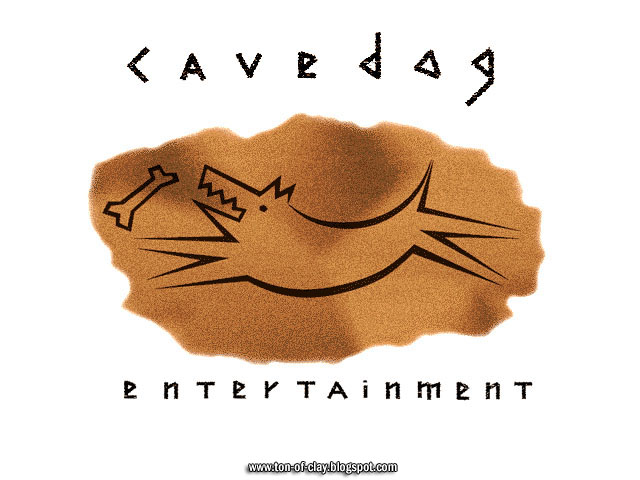
I fleshed them out a bit more at home that evening. Here is a rough Cavedog.


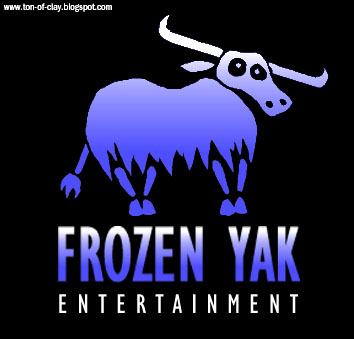
These two pictures were pinned up on the wall of the office Chris and I shared. It was put to a vote, and Cavedog won by a narrow margin. The pooch was ready for prime time. That sorry looking Frozen Yak wasn't completely lost. It was unearthed as part of an April Fools joke on the Cavedog website about a year later.

The Cavedog logo ended up on all the usual things like business cards, letterhead, hats and the all-important t-shirts. I've done a lot of logos over the years. I still think this is one of my better efforts. I wanted to evoke paleolithic cave paintings, while keeping the lines simple enough to stand out, even when printed very small.

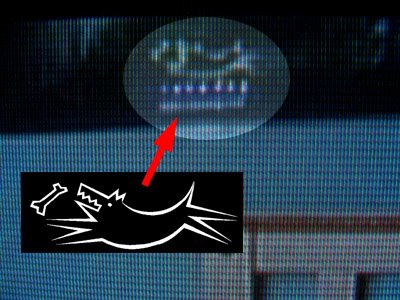
It did. I was relaxing at home in 2000, watching my favorite family entertainment, The Sopranos. It was season two, episode seven... the one called D-Girl. Toward the end of the episode, Sal "Big Pussy" Bompensiero was having a heart-to-heart with AJ in his room when something in the background caught my eye.

Could it be? A TA: Core Contingency poster in AJ's bedroom?

It is! You can just make out the Commander to the right, but the Cavedog is plain as day.

And there you have it. My small supporting role in television history. It's fitting that the Cavedog shared some screen time with the Big Pussy character, since both would be bumped off within the year.

CK


Friday, September 29, 2006

The Lure of The Shrimp Sub

Copyright 2001 Microsoft Corporation

This is the third of the four 3D concept pieces created for the Voodoo Vince green light meeting. Once again, Gary Hanna and his crew did a spectacular job. This portrays Vince in a mini-submersible shaped like a shrimp. It's funny how wonderfully clear the water is. It's like a tropical reef rather than the incredibly murky water one really finds in the bayou country. Real swamp water slooks like unfiltered apple cider, teeming with countless bugs and reptiles. But hey, zero visibility wouldn't be much fun in a game.

I mentioned the four "perfect world" pictures earlier, but I figured I'd talk about them a little more. After a year of meetings, rejections and building a demo we finally landed a deal with Microsoft. We didn't dive into production right away. There was a prototype phase first. We had six months to create a bigger, better, more detailed version of the demo, finish a first draft of the comprehensive general design doc (GDD), and initial draft of the technical design doc (TDD), and a detailed milestone list for the whole project with tasks, assignments and workflow charted out. We also needed to establish how the game would look. All this was wheeled into a conference room for the meeting. These images were brought in on 2 by 3 foot enlargements mounted on foam core (which delighted MS execs promptly snapped up).

The purpose of pictures like the one above was to allow Gary and his crew to create something that approximated how the finished game would look without bogging down the prototype itself. The theory was that we could then make the prototype visually crude and concentrate on gameplay.

That's a nice theory, but we ended up making the prototype as visually strong as we possibly could. Visual polish is a double-edged sword. Everybody says they can imagine how things will look in a rough version, but the inevitable "That's not final art, is it?" question is the bane of artists throughout human history. You just know it was said of the Lascaux bison. On the other hand, if you work too tight you can paint yourself into a corner, visually speaking. We decided to err on the side of polish. Voodoo Vince at six months looked better than a lot of finished games.

That paid off in the green light meeting, though we still had a lot of content to create before the game crossed the finish line.

CK

Wednesday, September 27, 2006

The Vince Storybook

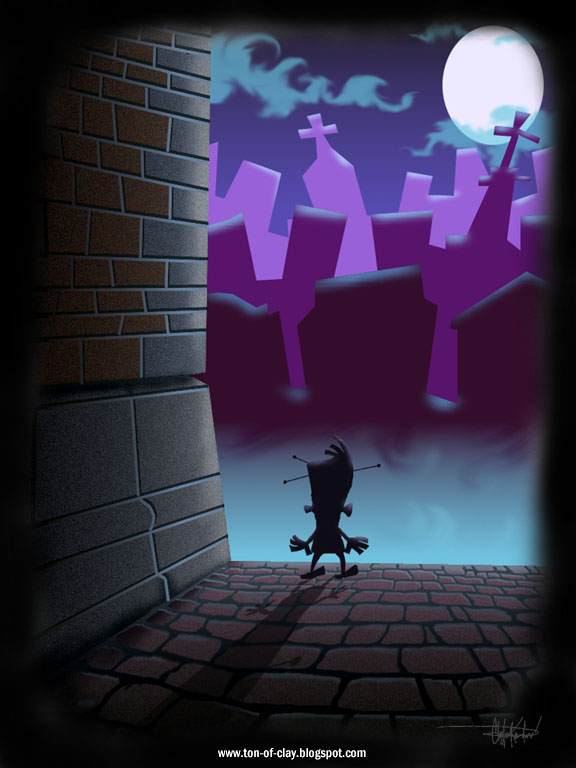
"In the darkest corner of the oldest voodoo shop in the French Quarter of New Orleans was a doll made of rags, twine, burlap and strange unspeakable things. He was named Vince."

My experience in the game industry has taught me that most people don't read... even all-wise, benevolent publishers are sometimes too busy to wade through a long wordy document. I decided to make understanding Vince as easy as possible for busy executives with too many concepts to evaluate. I wrote what amounted to a children's book and put it in the first concept/pitch doc for the game. This may be why I still hear from parents who say their kids are crazy about Voodoo Vince.

Vince's appearance didn't change too much from these early concept pieces.


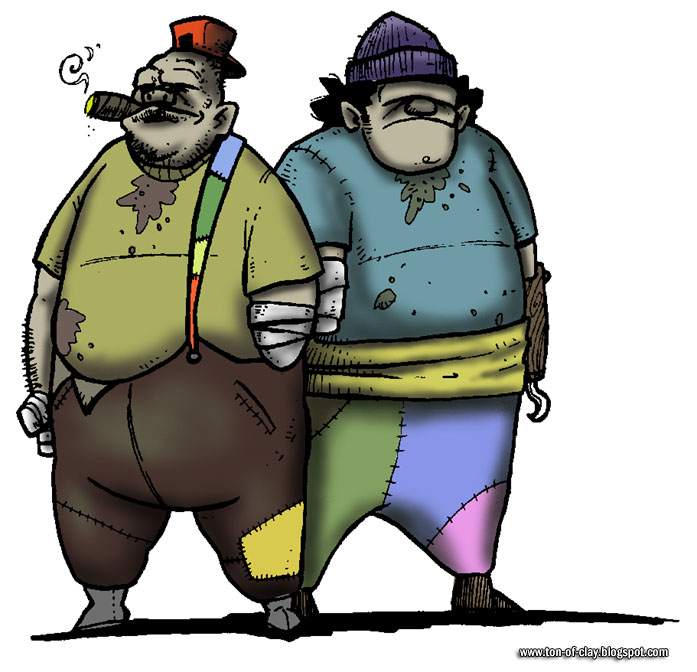
Kosmo and his goons (Jeb and Fingers) are much as they appeared in the game almost three years later.

Curio (above) and the roustabouts (above right) by Doug "Mr. Prolific" Williams.

The biggest changes were made to the Madam Charmaine character. She was originally called Madam Curio. We changed her name once we discovered there was a professional dominatrix using that moniker (gosh... thanks, Google). We also went with a somewhat younger look for her.


This approach was really well received. It opened doors and led to many upbeat meetings with publishers. I found that just about everybody "got" the idea behind the game. Everybody was enthusiastic about the concept too, but that didn't loosen any purse strings. It took a playable demo to accomplish that. But it was still a great way to establish some basic elements for Vince and his world.

CK

Tuesday, September 26, 2006

TA-ncient History #3: Mid Nano-Stream

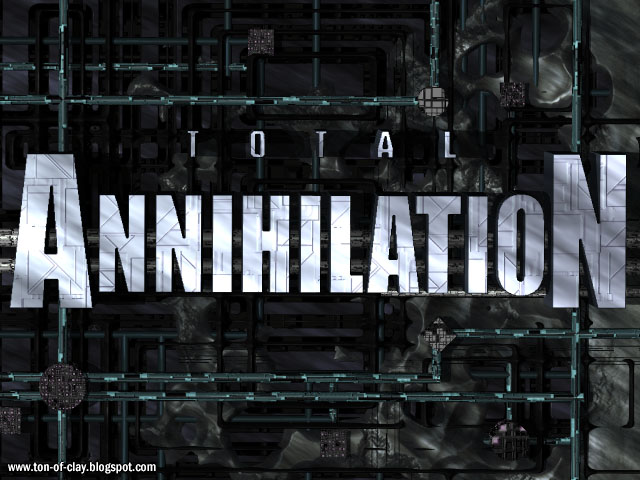
Backdrop for a temporary title screen - Fall of 1996

Total Annihilation came together fast. Really fast. The bulk of the game's code and content was created in less than a year. I credit this to two things: insane work hours and a good preproduction phase.

Preproduction is frequently overlooked and underestimated by publishers and game developers, even today. Taking the time to figure out tools, techniques and a look for a game sounds like good sense, but it is often written off as indulgent fluff. It doesn't always feel like you're producing something, and it's sometimes hard to show that you are (especially to a stressed out executive) but preproduction is incredibly useful. It gets a solid production pipeline in place, and makes it easier for a small core team to share the Kool Aid and quickly indoctrinate new recruits. I firmly believe that every week of preproduction saves at least three weeks of regular development time. It's true. I have notes.

By the Fall of 1996 we were gearing up for full production and adding staff in a hurry. A lot had happened by then. We had figured out our excuse for a story. We had marginally functional tools. We started getting a good feeling about the game.

We also had a new publisher. GT Interactive bought Humongous Entertainment in July of 1996. Chris and I had no clue that was going to happen. Saying we were surprised is putting it mildly. Total Annihilation was started under the auspices of a mom n' pop, bootstrap operation and now it belonged to some guys in New York. Stuff like that happens in business, but there were some moments of stress and consternation.

GT (originally initials for "Good Times") was as surprised as we were. When they bought the makers of Putt Putt, Freddi Fish and Fatty Bear, they were only marginally aware that an RTS game was lurking somewhere in the building. It seemed like a good match. GT had risen to be the third biggest game publisher by distributing Doom, Quake and Duke Nukem. Total Annihilation looked like it might be a good fit for them. The game would certainly get better distribution than it would have before the acquisition. Funding for TA's completion would also be on more solid ground. We did a quick demo for some GT Interactive execs about a month later and they seemed to like what they saw. So, it was full steam ahead.

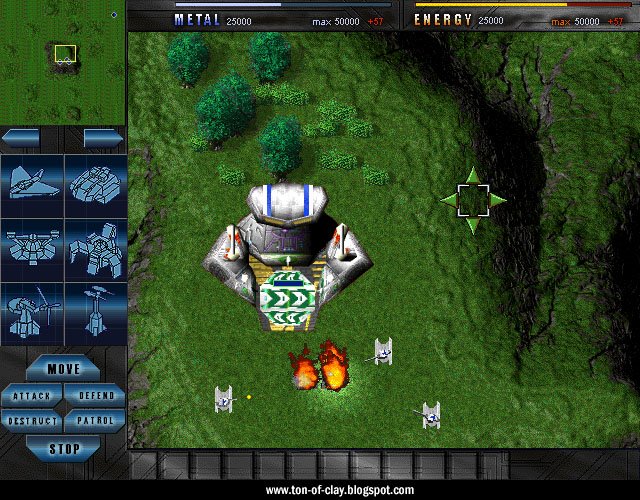
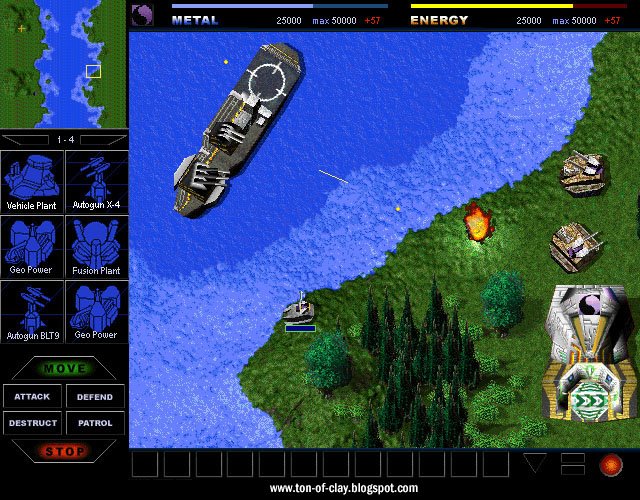
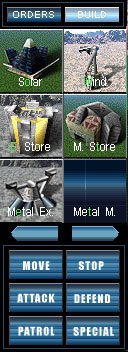
These screens are mockups from a time when different interface designs were being considered (though the maps and units are all legit). That's why there are structures and vehicles all mixed up on the same menu.


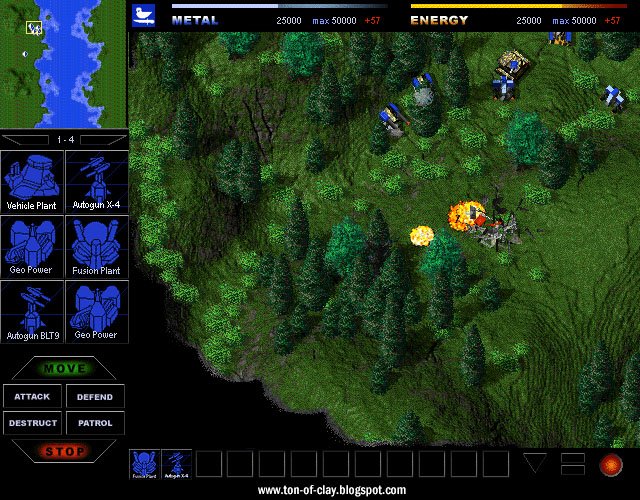
These are from January and February of 1997, or roughly the mid-way point of the production phase. This is just a month before we started making screenshots for our first print ad and our nearly nonexistent preview coverage.

It's still rough, but quite a difference from just a few months earlier. Many units will be familiar to anyone who has played the game, though some saw major changes in the months ahead. Let's have a fun "guess that unit" contest. We were briefly considering a whole heap of team symbols (including some suspiciously like lab glassware) for multiplayer, several of which can be seen here. Those were too hard to see on most units, so we just went with the basic Arm/Core insignias. The engine only supported 640 x 480 resolution at this point, which is why the UI looks gigantic and the units seem ready to crawl up your nose. Dig the groovy yin-yang on the Core Kbot lab.


The build buttons are from a brief phase where I thought a blueprint sort of look might work. We had all those 3D models, so a simple shot of the wireframe seemed like a good place to start.

That brings up an issue we had. There were continual headaches with those itty bitty polygonal units. It was always a challenge to make them distinctive and engaging. Everybody knows what an airplane or tank looks like at a glance, but the same wasn't true for a damn K-bot lab, much less a metal storage facility. The software renderer wasn't helping much either. Textures tended to shift and "swim" a lot. Early incarnations of the engine often had polygons popping in and out of existence depending on the barometric pressure that day. We were genuinely concerned about how our little robots and gizmos would stack up against the crisp prerendered sprites found in so many other games. We knew our game would have an edge once people saw the units in motion, but we were never happy with how the units looked in static screen shots.

This lead to the final version of the build buttons. Ron Gilbert suggested we go with small "glamor shots" to help sell the units visually. At left is an early version of a build menu for Total Annihilation.

The "unit problem" also lead to the creation of our animated screenshots, the first of several novel ways we used that newfangled Internet thing to find and build an audience for the game.

CK


Saturday, September 23, 2006

More Chunktastic Pixel Love


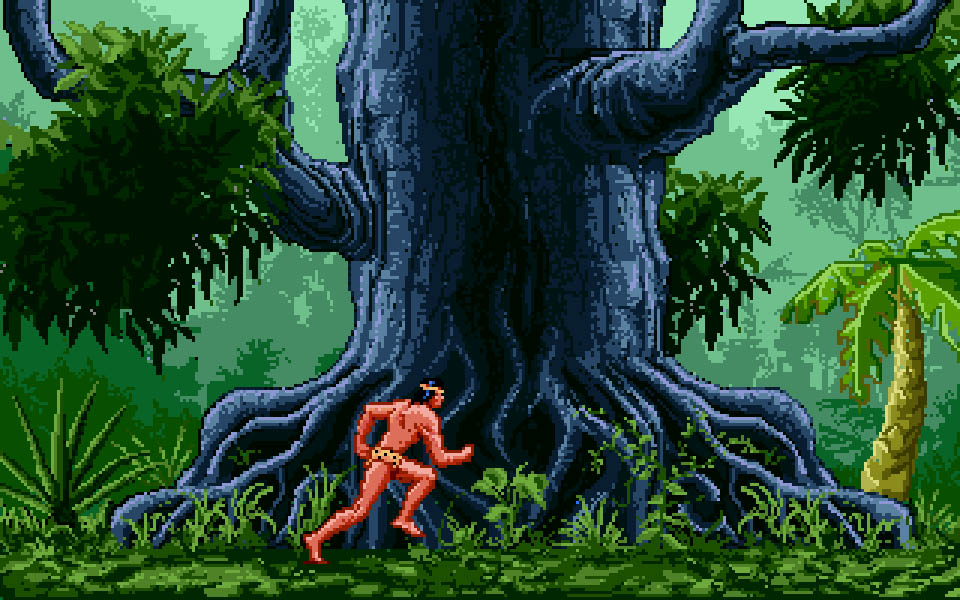
This screenshot is from an unreleased Tarzan game for the SNES. Manley was developing it for the now-defunct publisher GameTek. This image probably dates from late 1993. The Tarzan character was done by Jim Bradrick, a highly skilled classical animator and master chili chef. Jim turned me on to the music of Django Reinhardt during this project, which would later have a big impact on Voodoo Vince.

The background, including the strange blue tree, are mine. This was probably near the ultimate saturation point for 16-bit sidescrollers. I think publishers were shoveling any character with limbs into a sidescroller (and some without).

The project was pretty close to content complete when it was canned. We had stumbled along for a good five months without any real design, apart from what the artists and programmers cobbled together on the fly. The game's cancellation may have been related to the way good ol' Tarzan methodically slaughters his way through the endangered species list over the course of the game. The fact that doing so wasn't even fun just sealed the deal.

This is a sort of interesting halfway point in the look of 16-bit tile based games. Lots of games still had little tiles... a "chicklet" look to their backgrounds. The limits of the NES were still embedded in how many developers worked. But games started to appear with a more thoughtful approach to how tilesets could be used. Lush, rotoscoped games like Flashback and even Disney's Jungle Book got a lot of developers thinking differently about tile graphics and animation. I was shamelessly ripping off Flashback with the background foliage here.

Just a year or two later, games like Earthworm Jim and Donkey Kong Country would take tile graphics even further, just in time to see the platform give way to the first generation of 3D consoles. As usual, developers start getting the best from a piece of hardware right before its trip to the scrapyard.

CK

Tuesday, September 19, 2006

Vince Cutting Room Floor #2: The Skeeterhawk

Of all the stuff from the Voodoo Vince cutting room floor, this is probably the cuttingest roomy flooriest. You see, once a project gets underway and the tires of software production meet the asphalt of reality in the great rally race of gaming excellence, a lot gets changed, rearranged and just plain hacked off.

The Skeeterhawk is a good example. I originally planned a sizeable riverboat level between Brusque Manor and The Bayou. The Skeeterhawk (ol' Southern slang for a dragonfly) had some ambitious ideas, including the illusion that the whole thing was steaming up the Mississippi. Vince would be trapped aboard until it reached its destination, which would naturally happen after he fought a bunch of monsters, solved some thorny puzzles and a emerged victorious from a climactic riverboat race.

Kids just love them zombie riverboats.

The whole game was ambitious. It's always good to aim high so there is still something decent left after the inevitable cuts occur. There were things I really liked in this level, but some of the puzzles and characters didn't quite come together the way they should have. Given more time I'm sure it would have shaped up, but there was a schedule to keep and everybody felt it made more sense to focus on the quality of other levels instead of just churning out some potentially shakey real estate for Vince to explore. It was a sad day, but the Skeeterhawk was sacrificed on the altar of expedience and common sense.

Man, I hate that altar sometimes.

Supersweet concept art by Doug Williams (again)

In retrospect, I have to admit I wish I'd nuked Roachfort instead (more on that later), but you know what they say about hindsight: It can really suck.

CK

Monday, September 18, 2006

Bat Lady... With Flapping Action!

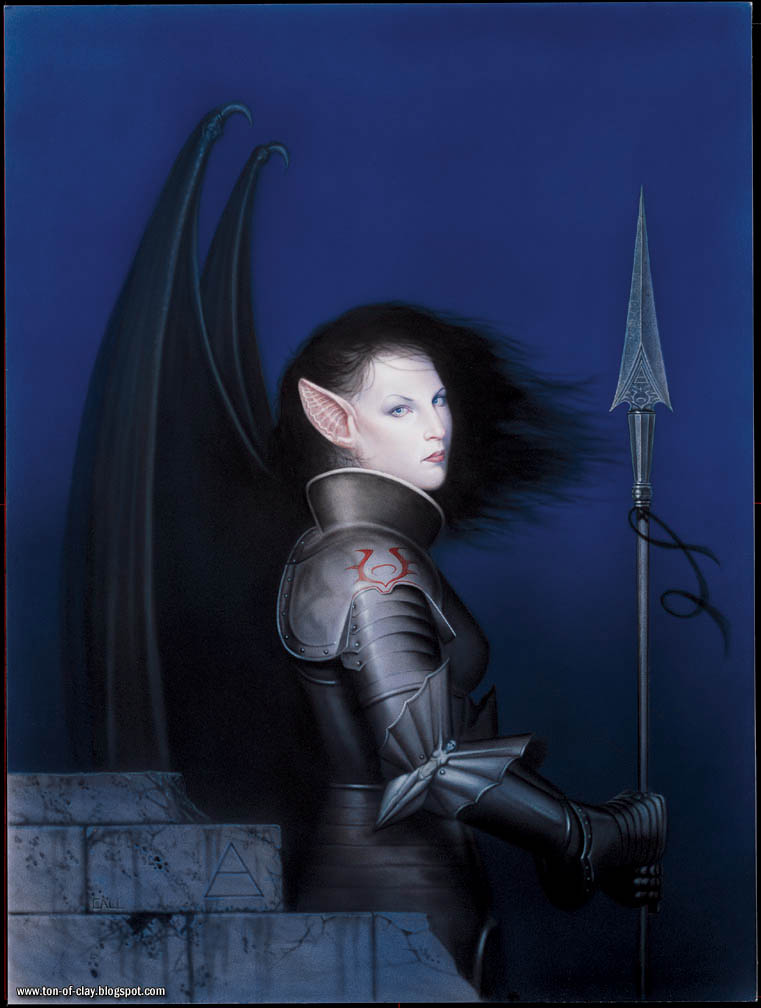
This is Thirsha, head honcho of Zhon from Kingdoms. A fine leader in spite of her wacky ears.

An amazing amount of content is created for nearly any game. We had over twenty artists on the team for Kingdoms plus another half dozen or so contract artists working off site. In addition to all the units, maps and interface art there was an incredible heap of pictures made for the cinematic sequences known as the Book of Darien.

This painting is by the brilliant illustrator Greg Call. Greg did portraits of the four monarchs as well as the superb box art for Kingdoms. He was a real treat to work with. Besides being a talented artist and a nice guy, Greg put a lot of effort into learning about the world and its characters before tackling this assignment. I especially like the winged figure worked into the vambrace and the subtle Zhon insignia on the spear.

This piece was seldom seen in its original state. It was cropped and heavily compressed in the movies or reproduced at a small size in various print ads. Here's the whole picture in all its batty goodness.

CK

Saturday, September 16, 2006

Voodoo Shop Triviata

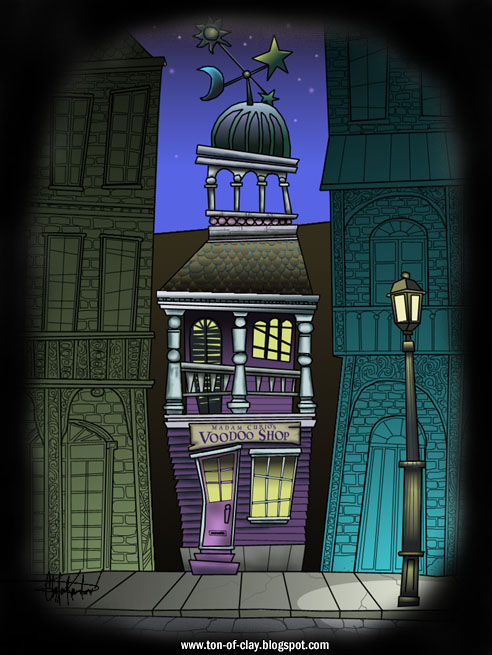
Madam Charmaine's voodoo shop serves as the setting for the game's front end in Voodoo Vince. After flying through the front window after the sundry logo screens, most users probably zoom to the crystal ball to continue their game, but using the joystick will take the camera from one corner of the shop to another. If you look in the background, you'll see some pretty silly things.

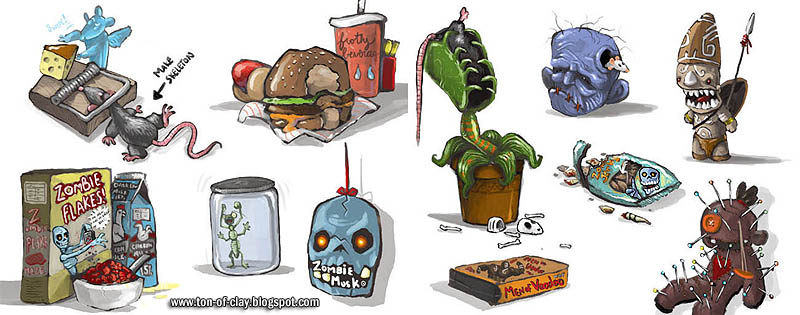
Before the level artists went to work filling the shop with a lot of nifty Voodoo clutter, Doug Williams came up with a whole lot of ideas for various decor items. Here are some of his funnier ideas.


I think everyone needs a pickled businessman in a jar. Not everything made it into the game. I know the Zombie Flakes, the carton of chicken milk and the poor little trapped bug are pretty easy to see in the background at different spots around the final version of the shop. The saucy "Men of Voodoo" video cassette didn't, but there's an idea waiting to happen if I've ever seen one.

CK

Thursday, September 14, 2006

TA-ncient History #2: The Non-Story Story

What the hell?!? Did Duke Nukem and Vanilla Ice have a love child?

Total Annihilation was well received for it's gameplay and design innovations, but there was some criticism for its lack of a deep, engaging story. The heavy hitters in the RTS genre all had swell movies, choc full of the best cut scenes 3D animators and B-list actors could provide.

We started the project firmly convinced we could somehow pull together long, ambitious, jaw-dropping cinematics. During the first couple months, Chris Taylor and I laughed ourselves silly with random ideas for a premise. If we ended up snorting teriyaki and Diet Coke out our noses, we'd put it in the story.

We were leaning toward an extremely, violent, comedic style that would be familiar to fans of the Venture Brothers today. We knew we had a central figure in the Commander. We had a limited budget, so we figured he would be the only real character in the intro movie. The idea was that the Commanders were identical clones who were at war over the shape of the glassware in which they were spawned.

Yes, I'm serious.

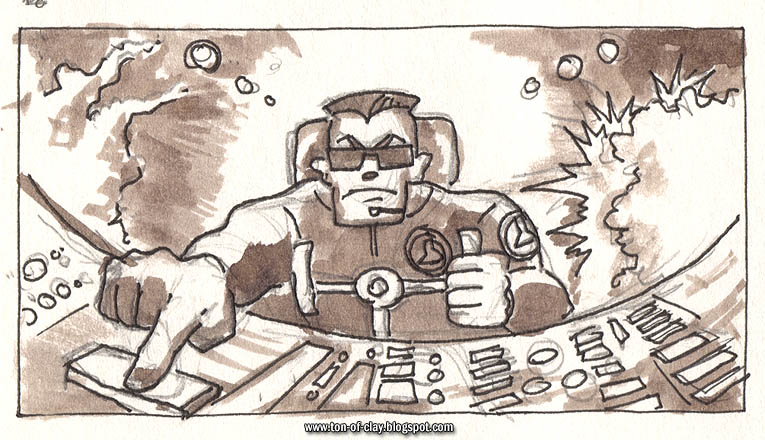
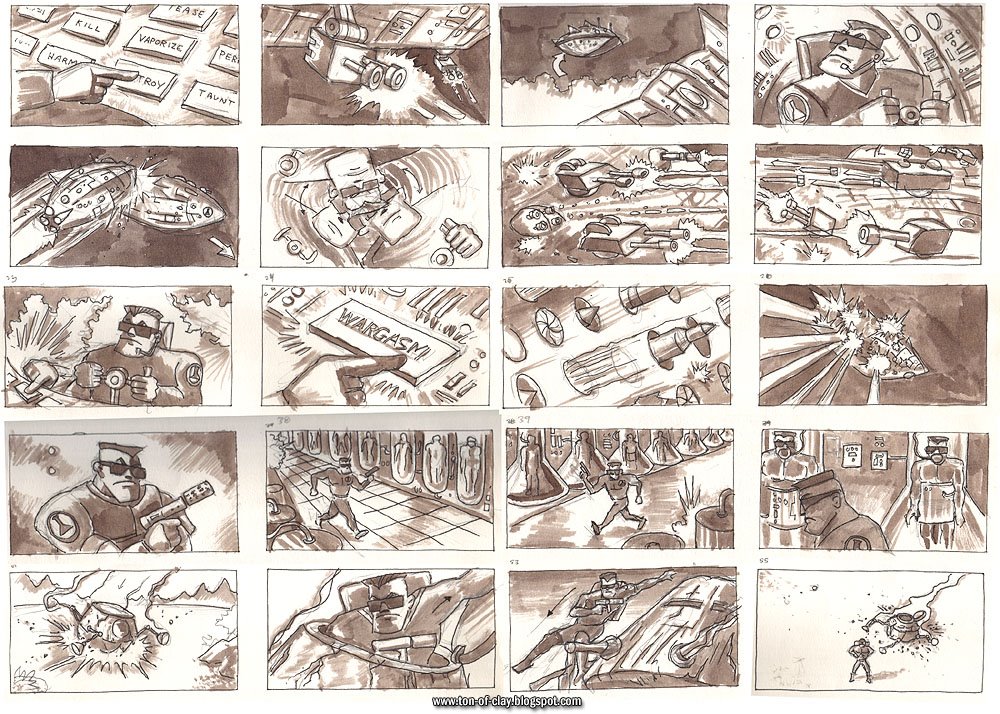
One had a regular test tube as part of his insignia. The other had an Erlenmeyer flask. I went home one weekend and whipped up a storyboard for a long, drawn out space battle between two gigantic starships, ending with both Commanders crashing on a desolate alien world. There, they would duke it out to the death. Hot n' spicy... Total A style.

Here are some excerpts from the insanely long storyboard...
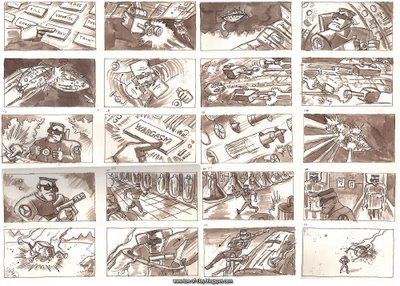
Don't worry. We came to our senses. It soon dawned on us that we could have no such thing in the game. We thought the ideas were a hoot, but they would have cost more than the game's whole budget to make. Keep in mind that Total Annihilation was made for a very modest 1.2 million bucks. Game developers spend more than that on Red Vines and spa treatments these days. We scaled back to simple mission briefings with static graphics and settled for a short intro sequence, and a couple of short movies for the end of each mission series.

A while later, we came up with the names of the sides. Chris and I batted names back and forth like "The Syndicate," and "The Corporation" for our villains. Chris shortened that to simply "the Core." Unit artist Clayton Corbisier came up with "the Arm" for our so-called good guys. He just liked the sound. We did too. Chris then asked me to go home and come up with a simple backstory one evening. He said, "Just some good guys, some bad guys and some reason they're fighting. That's it."

I came back the next day with a document outlining the war between the Arm and the Core, along with some history and possible story arcs for the game. Here is an excerpt:

"Once, the galaxy was united and whole — ruled with scientific precision by the Core. Their citizens lacked nothing. At the zenith of their civilization, the ultimate dream was realized: immortality.

"Those receiving this awesome gift were selected by Core Central. Their minds were carefully recorded as an advanced digital simulation. Weak and fallible human flesh was cast aside and a perfect, artificial body of dreadful abilities housed the remaining consciousness. This guaranteed that the best and brightest minds could be of use to society indefinitely.

"This practice made certain factions uneasy — most notably the best and brightest minds in the galaxy. Not every promising leader looked forward to this “immortality”. Gradually, this faction united and chose to live where the influence of the Core was weakest: in a remote spiral arm of the galaxy. As their numbers grew they became known simply as the Arm.

"This war of ideas became a war in fact. Uneasy with an increasingly vocal opposition, the Core decided to squelch this provincial backwater.

"At first, the Core had a clear advantage. Most of the population and resources of the galaxy were still theirs. But the Arm had a certain resourcefulness that stopped the Core’s best attempts to eradicate them. The Arm learned something new with each encounter, eventually building a war complex to rival that of the Core. What started as a minor skirmish soon blossomed into a vast conflict which would last for thousands of years."

This was later spruced up by veteran game writer, Dave Grossman for the now-familiar (and much catchier) intro sequence to Total Annihilation:

"What began as a conflict over the transfer of consciousness from flesh to machines escalated into a war which has decimated a million worlds. The Core and the Arm have all but exhausted the resources of a galaxy in their struggle for domination. Both sides, now crippled beyond repair. The remnants of their armies continue to battle on ravaged planets; their hatred fueled by over four thousand years of total war. This is a fight to the death. For each side the only acceptable outcome is the complete elimination of the other."
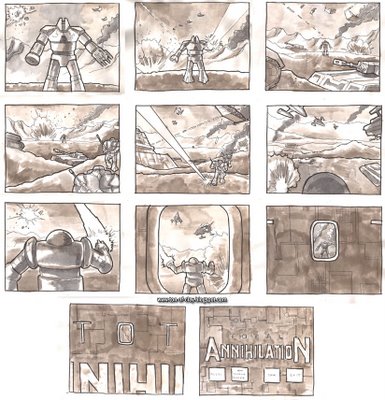
Ah... That's better. Above is my rough storyboard that served as the framework for the intro cinematic to Total Annihilation. Proper units and many more shots were dropped in later, though the Arm Commander didn't change that much.

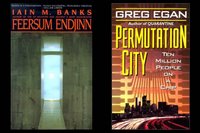
It's pretty basic stuff, but there are some influences I can cite. I had been reading books with vivid portrayals of what might become of humanity if digitized simluation of human consciousness were a reality. The first was Feersum Endjinn by Iain Banks. The second was Permutation City by Greg Egan. Banks deals with a fantastic distant future where the dead live on in a digitized afterlife using a vast computer built into the crust of a planet. Egan portrays early attempts at digitizing a human mind using a more contemporary setting. Both are great reads, by the way, and influenced my thinking when I went home to cook up that skinny premise for TA.

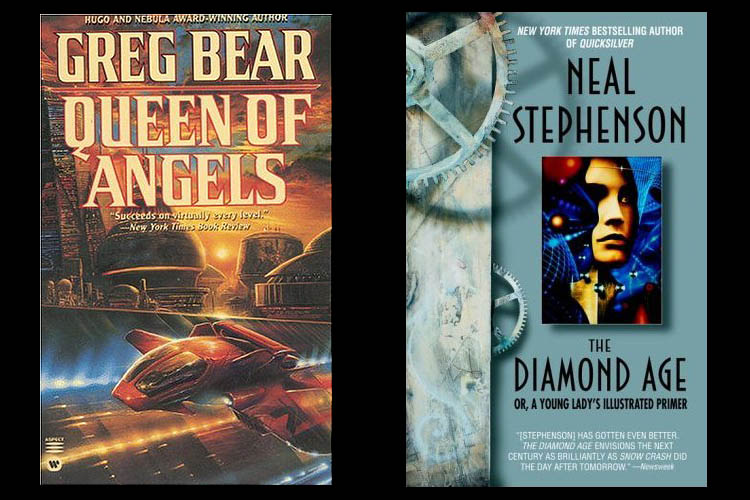
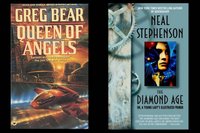
The inclusion of nanotech was for pure convenience. This was about the time we were trying to figure out how to portray construction in the game. It would have been too complex and time consuming to have little guys with hammers and scaffolds every time something was built in the game. It also wasn't futuristic enough. We needed something like magic, but with a thin veneer of science around it. Nanotechnology to the rescue! Two other books influenced my thinking here - Queen of Angels by Greg Bear and Diamond Age by Neal Stephenson. The former has a great segment describing the formation of a building inside what amounted to a gigantic glass jello mold. I thought something like that might fit our super cool futuristic war pretty well. Diamond Age vividly portrays nanotech used in both fabrication and warfare. I proposed the "nanolathe" as the basis for our construction technology. One of the programmers came up with a particle effect (sort of like futuristic space pee) and we were set.

For all that, it's still not much of a story. We were about to enter the Great Real Time Strategy Bloodbath of 1997 and we had a plot you could sum up in one paragraph. Were we crazy?!?

Yes and no.

The lack of story might have turned off a wider audience, but it left plenty of room for all sorts of great expansion and extrapolation. There was room for players to project their own imagination into the story. After I handed off that doc, I didn't write another word about the TA universe. That was okay. Everybody else ran with it. The mission designers added a ton of ideas and all sorts of interesting plot twists. Fan fiction has taken the saga of the Arm and the Core to a whole new level. The Core is no longer a two dimensional villain, and the Arm isn't just a bunch of pouting malcontents. A real, vibrant universe now hangs on the bones of Total Annihilation's spartan backstory.

I wouldn't have it any other way. Not for all the test tubes in the world.

CK

Tuesday, September 12, 2006

Flaming Zombie Rats

Copyright 2001 Microsoft Corporation

This is another of the early visual prototype screens produced by Gary Hanna and his awesome team in the Fall of 2001.

People have sometimes asked why our version of the French Quarter was so twisty and bendy when the city of New Orleans was originally laid out using straight Cartesian principles. That's mostly a question of art direction, but I'm convinced that part of this has to do with the city itself. It just feels bendy. After a few Hurricanes, everything does. Even Descartes would have a hard time finding his hotel.

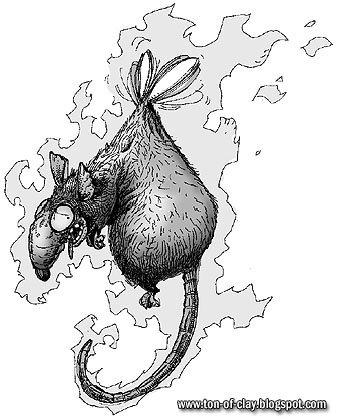
Ah, flaming zombie rats. We hardly knew ye. These were probably my favorite concept among the first generation of monsters we created for Voodoo Vince. They sort of floated around the French Quarter moaning and farting little fireballs. They were eventually cut and replaced with the Bomber Beetles. They were charming, in a bizarre sort of way, but were too lackluster and sad once we saw them in action.


Another part of the game that saw numerous changes was the combat system. The first approach we tried can be seen in the way Vince is attacking the hapless FZR. At one point we tried a system where all combat was carried out by Vince harming himself. Each time he stabbed, beat or burned himself a jolt of magical stuff would create the appropriate reaction in the enemies.

It had potential but there were some intrinsic problems, most of which had to do with Vince feeling too isolated from the monsters. I'll get into that whole story in a later post.

CK